Environmental effects on
methane uptake in the marine environment
4.1 Introduction
Microbial
processes are involved in the exchange of many trace gases between the
atmosphere and various ecosystems.
Although considerable research has focused on measuring methane
emissions from major biological sources (Seiler and Conrad, 1987; Cicerone,
1987,1988; Conrad, 1996; see Chapter 1) much less is known about the magnitude
of the factors controlling biological sinks of methane. It is imperative that a better understanding
of the chemical and biochemical processes controlling the emission of methane
is achieved, particularly in the development of models to predict the role of
methane in climate change.
4.1.1 The role of methane oxidation
The
flux of methane to the atmosphere is likely to be mediated to a large extent by
methane-oxidising bacteria (see Chapter 3), of which many strains have been
enriched and isolated from a number of environments (see Chapter 1, see Chapter
6). This biological oxidation of
methane has been recognised as being globally important (Gal'chenko et al., 1978; Frenzel et al., 1990; Conrad and Rothfuss, 1991;
DeAnglies and Scranton, 1991; Reeburgh et
al., 1993; Prinn, 1994; Bender and Conrad, 1995) and the process plays an
important role in reducing emissions of methane to the atmosphere (Kightley et al., 1995). These metabolic processes have the potential to be affected by
environmental variables acting either on the enzyme activities that have been
expressed by the resident methane-oxidising bacterial populations, on the
synthesis of new enzyme activities, or the proliferation of particular
methane-oxidising bacteria. (Conrad, 1996).
Thus much interest has focused on the role of aerobic methane oxidation
and on the ecological and anthropogenic practices that affect this process
(Ojima et al., 1993).
Aerobic
oxidation of methane requires the availability of oxygen, the presence of
methane-oxidising bacteria and suitable physicochemical conditions that allow
the bacteria to be active (King 1993).
From field studies, physicochemical variables have been demonstrated to
influence rates of methane oxidation in soil (Mancinelli, 1995), and have been
shown to affect community structure (see Chapter 5). Major factors which influence the biological methane oxidation
process include: oxygen, temperature, pH and N-content (Jones and Mortia, 1983;
Bedard and Knowles, 1989; Adamsen and King, 1993; Goulding et al., 1995; Hutsch et al.,
1994; Bronson and Mosier, 1994; Boeck and van Cleemput, 1996; see Chapter 3).
4.1.2 The importance of estuaries
Estuaries
have historical and continuing importance to human activities, forming the
dominant route for transportation to the ocean of material derived from the
weathering of continents, and thus forms one of the most complex of all
environments. The estuarine environment is amongst the most productive and
sensitive of ecosystems. River runoff
of nutrients and organic matter to the oceans forms a coupling between the
terrestrial and marine ecosystems.
The
distribution of nutrients and organic matter in estuarine waters are
controlled, in common with other physiochemical properties (i.e. temperature,
dissolved oxygen, and salinity), by the nature of the estuarine circulation,
mixing and other physical processes, together with biological, sedimentological
and chemical effects. The mixing of river water and seawater results in
gradients of ionic strength, composition and pH. The mixing processes of the turbulent flow in estuaries bring
about changes in concentrations of dissolved particles. The result is pronounced changes in
physiochemical characteristics during the mixing of river water and seawater.
There is close coupling between estuarine processes in the water column and
sediments, which lead to a variety of reactions of geochemical significance
(Burton, 1988). The principle processes
affecting the distribution of chemical species in estuaries may be summarised
in figure 4.0.
|
|
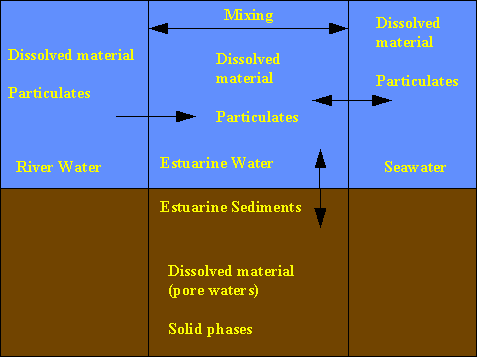
Figure 4.0 Schematic representation of important processes in estuarine
chemistry
Modified
from Burton, 1988
Anthropogenic
activities in and around estuaries have often led to disposal of waste directly
to the estuary, leading to many estuarine environments adjacent to human
activity becoming polluted (Clark, 1992).
These pollutants all contribute to the environmental degradation of
coastal seas (Kersten et al., 1988).
Deforestation and agriculture in the catchment area, as well as waste
discharges can change the natural equilibrium in the estuary resulting in a
stressed environment. The perturbation of the estuarine environment has,
potentially, a defined effect on the methane oxidation capacity of the system.
4.1.3 Study Aims
While
it is well established that the increased methane burden in the atmosphere can be
largely attribute to human activities (see Chapter 1) there has been little
work on environmental variables that might effect microbial oxidation of
methane in the estuarine environment.
Considering the extensive range of both methane concentrations and
oxidation rates in the Tyne estuary (see Chapter 3), any changes in this highly
unstable environment might either enhance or mitigate the net emission to the
atmosphere. Although oxidation rates
have been reported for a range of environments (see Chapter 1) very little is
known about the controlling mechanisms.
The
objectives of this study were: -
·
To improve our understanding of methane exchange from the
estuarine environment.
·
To obtain a better understanding of the ecology of
methanotrophs, in an attempt to elucidate the mechanisms that regulates methane
oxidation in the estuarine environment.
The aim
of this study was to observe methane oxidation rates under a variety of
physiochemical regimens. Thus
recognising what potential factors control methane oxidation
4.2 Results
The
effects of physicochemical properties on methane oxidation rates were tested by
measuring methane oxidation rates under a variety of physicochemical regimens
(see section 2.7). Figure 4.1 shows the
sampling point and a variety of physicochemical variables measured on the Tyne
estuary and figure 4.2 shows the strategy used to observe the physicochemical
regulation of methane oxidation.
Samples were collected from the sampling position and all experiments
were done in vitro (see section 2.6).
|
|
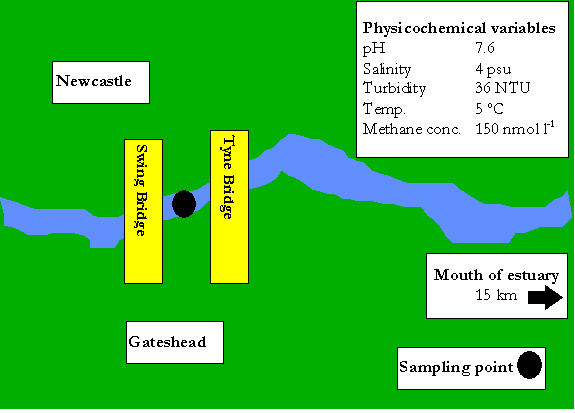
Figure 4.1 Position of and physicochemical
variables of sampling station (October 1996).
|
|
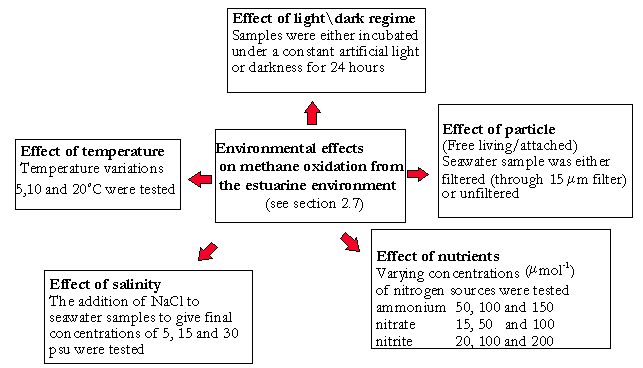
Figure 4.2 Flow chart showing the protocols used to examine
physicochemical effects on methane oxidation in the estuarine environment.
In the
analyses of methane oxidation rates and the effects of environment variables
all were measured in duplicate in the dark, unless otherwise stated. In
examining the effect of environmental variables, methane oxidation, was
estimated by measuring the cell matter and carbon dioxide, formed during the
oxidation process of methane (see section 2.2) which provides the measurement
for methane oxidation rates.